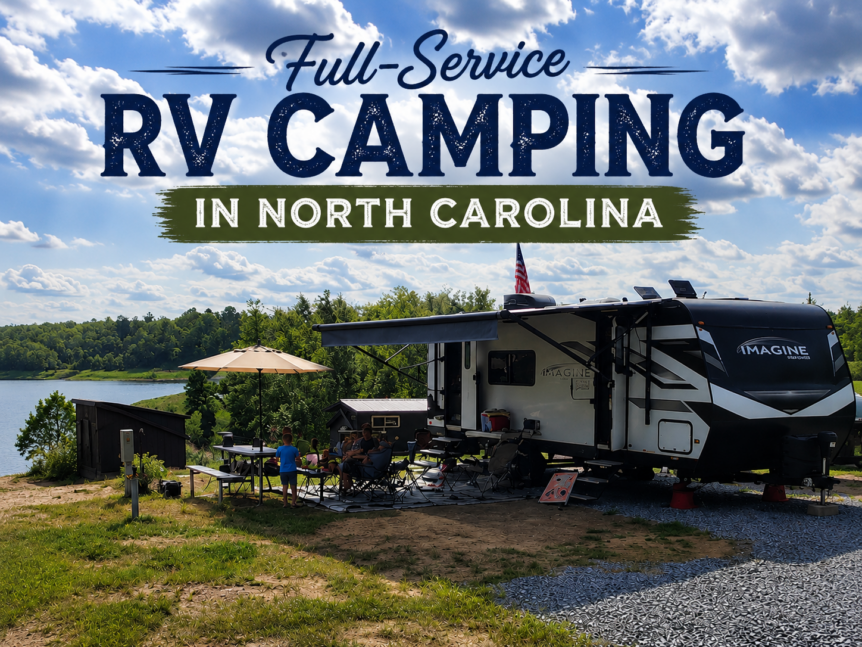
Full-service RV camping means a site with all three core hookups: water, electric, and sewer, plus the amp service to run your rig like a house. That’s the technical definition. In North Carolina, though, that baseline shows up reliably at private resorts and far less consistently at public campgrounds, where partial hookups or none at all are the norm. Knowing the difference before you book is the single biggest factor in whether your trip feels like a vacation or a chore.
This guide breaks down what “full-service” actually includes, what North Carolina adds to that equation, what a resort should honestly promise, and what a complete example looks like in practice.
What “Full-Service” RV Camping Actually Means
Full-service gets used loosely in camping marketing. Sometimes it means full hookups. Sometimes it just means there’s an on-site pool. For this guide, we’re using the term the way serious RVers do: a site equipped to run your rig the same way you’d run a house, without managing tanks or hunting for a dump station.
Full Hookup vs. Partial Hookup vs. Primitive Camping
There are three tiers, and the difference matters more than most first-time campers expect.
| Hookup Type | What’s Included | What You Manage Yourself | Best For |
| Full hookup | Water, electric, and sewer connections at your site | Nothing, just connect and go | Longer stays, families, and anyone who’d rather not think about tank levels |
| Partial hookup | Water and electric only | Black and gray tank dumping, usually at a shared dump station | Shorter stays, budget-conscious campers are comfortable with one extra step |
| Primitive camping | No connections at all | Fresh water tank, battery power, and both holding tanks | One or two nights, experienced RVers take off-grid trips |
North Carolina has all three tiers in play. State park campgrounds frequently offer partial hookups or none at all. Private resorts are where full hookups become standard, and where the “full-service” label starts to mean something real.
The 20/30/50 Amp Question
Electric service comes in three sizes: 20 amp, 30 amp, and 50 amp. Smaller campers and pop-ups often run fine on 20 or 30 amp. Larger rigs, including fifth wheels and Class A motorhomes running multiple AC units, need 50 amp to keep up.
If your RV’s cord and the campsite’s pedestal don’t match, you’ll need an adapter, commonly called a dogbone, to bridge a 30-amp plug to a 50-amp outlet or vice versa. A genuinely full-service resort offers 20, 30, and 50 amp service across its sites, so you’re not stuck improvising one.
What North Carolina Adds to the Equation
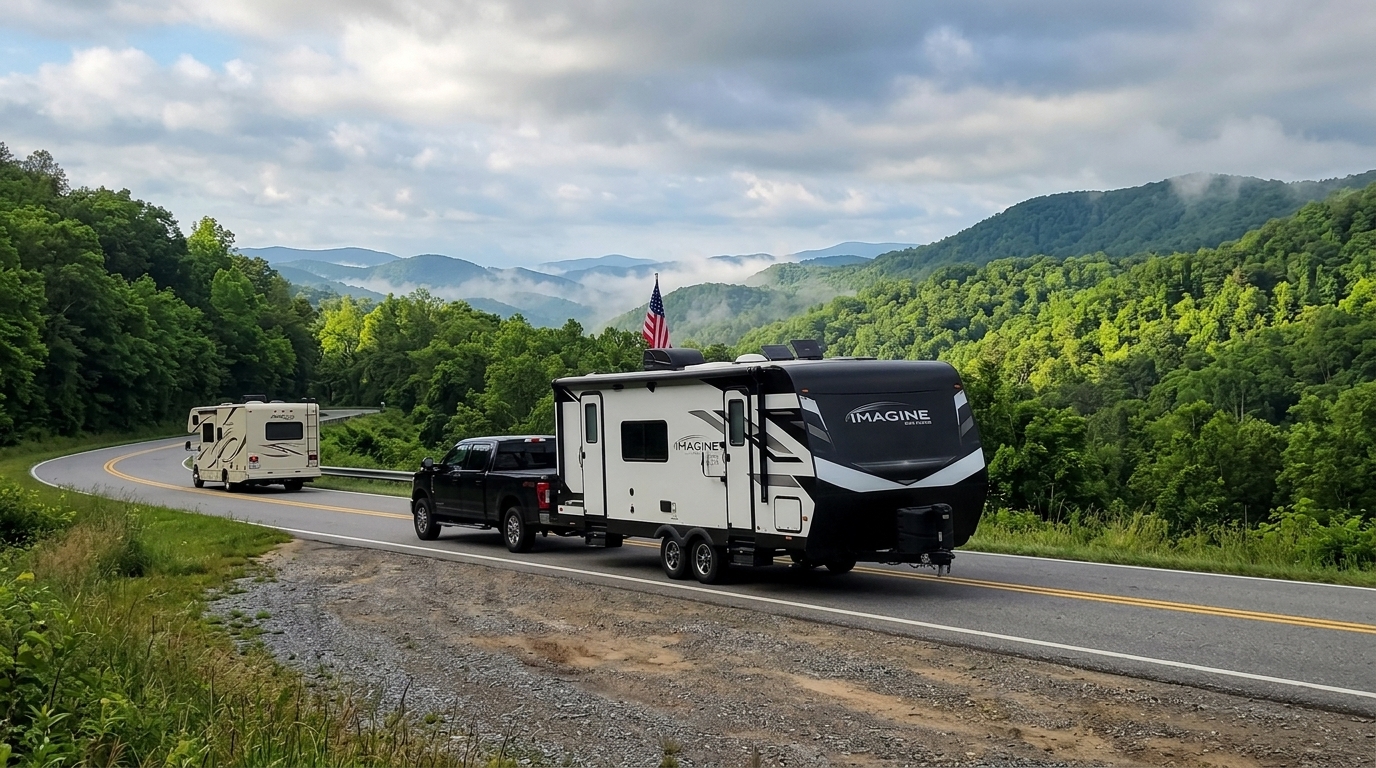
Camping logistics shift once you cross into North Carolina’s mountains. A few state-specific details are worth knowing before you book.
NC’s Actual RV Size and Length Limits
North Carolina caps RVs at 102 inches wide and 45 feet long, with travel trailers capped at 35 feet. Maximum height is around 13.5 feet, and a tow vehicle and trailer combination can’t exceed 60 feet in total. Most resorts that advertise themselves as “Big Rig-friendly” mean they can comfortably fit rigs at or near these limits. It’s worth confirming directly if you’re driving anything oversized.
Mountain Weather and What to Pack for It
Western North Carolina’s weather swings more than people expect, especially in spring and fall. Pack layers, bring rain gear, and check that your RV’s heating system actually works before you leave the driveway. Low-hanging branches and narrower mountain roads are common in this part of the state, too, so give yourself extra clearance when you’re navigating in.
What a Full-Service Site Should Include (and What It Won’t Promise)
A resort calling itself full-service should deliver more than hookups. Reasonable expectations include reliable WiFi (though signal strength in mountain terrain varies more than it does at coastal or city campgrounds), cable TV, on-site laundry, and a pet policy that’s actually clear before you arrive, not buried in fine print at check-in.
What it shouldn’t promise is a flawless, hassle-free fantasy. Honest expectation-setting matters here. Site spacing at East Coast resorts tends to run tighter than what Western RVers are used to, simply because there’s less land to work with. Cell and WiFi coverage can drop out in valleys and dense tree cover, even at resorts that advertise WiFi as an amenity. And it’s worth saying plainly: photos on a campground’s website can be years out of date. If a gallery looks suspiciously perfect, ask for recent images or check third-party review photos before you book.
What Full-Service RV Camping Costs in North Carolina
Pricing varies more than people expect. A no-frills public campground site, often with partial or no hookups, typically runs somewhere in the $15 to $25 a night range. Private full-hookup resorts generally cost between $45 and $90 a night, depending on location, amenities, and time of year. Premium resorts with extensive amenities or waterfront access can run higher still, especially around holidays.
Rates change by season and by site type, so the most reliable number is always the one you get straight from the resort. Contact Lake James Camping Resort & Marina to confirm current rates and availability before you plan your trip.
Full-Service, Plus a Lake: What Lake James Camping Resort & Marina Adds
Lake James Camping Resort & Marina sits on the eastern shore of Lake James in the foothills of the Blue Ridge Mountains, and it builds on the full-service definition above instead of just meeting it. Every RV site here is a true Big Rig-friendly, full-hookup spot with water, electric, sewer, and cable, plus 20, 30, and 50-amp service, so the adapter problem from earlier in this guide isn’t an issue here.
An On-Site, 140-Slip Marina, Not Just a Boat Ramp
Most full-service resorts stop at hookups and a pool. Lake James adds a 140-slip, full-service marina right on the property, with golf cart access from your RV site straight to your boat slip. Your boat stays in the water. You don’t have to launch and load it every time you want to get out on the lake.
Four Miles Off I-40, Exit 94
Getting here doesn’t require a detour through back roads. Lake James Camping Resort sits just 4 miles off I-40 at Exit 94, a straight shot for travelers coming from Charlotte (about 1.5 hours) or Asheville (about 45 minutes).
What to Expect Before You Book
A few practical details are worth knowing ahead of time. RV sites here are reserved for self-contained RVs that are 10 years old or newer. The resort’s marina operates year-round; for current-season RV site availability, it’s worth a quick call to confirm dates before you commit.
The property is gated, and demand runs high enough that both RV sites and marina slips maintain an active waiting list, which says something about how the place holds up once people actually stay here.
Cabins at Lake James are 100% pet-friendly, fully furnished, and a solid option if you’re traveling without an RV at all. If you’re bringing a pet to an RV site specifically, confirm any size or breed details when you book.
Golf cart rentals are available if you’d rather not walk the property, and the resort’s reservation and cancellation policy is worth a read before you put down a deposit.
It’s the kind of place the resort’s own tagline sums up better than any amenity list could: No Salt, No Sharks, No Worries.
Frequently Asked Questions For Full-Service RV Camping in North Carolina
What does “full-service” RV camping mean?
It means a site with all three core hookups, water, electric, and sewer, so your RV runs the way it would at home, with no tank-monitoring or dump-station runs required.
What’s the difference between full hookup, partial hookup, and primitive camping?
Full hookup includes water, electric, and sewer. Partial usually drops the sewer connection. Primitive has none of the three, relying entirely on your RV’s own tanks and battery.
How big of an RV can I bring to a full-service resort in North Carolina?
State law caps RVs at 102 inches wide and 45 feet long, with travel trailers limited to 35 feet. Individual resorts also set their own site and age requirements, so confirm both before booking.
How much does full-service RV camping cost in North Carolina?
Rates vary by region and amenities, generally running from around $15 a night at bare-bones public sites up to $90 or more at full-hookup private resorts. Contact the resort directly for current rates.
Is full-service RV camping available year-round in North Carolina?
It depends on the property. Some resorts close seasonally, while others, including marinas, operate year-round. Always confirm current-season availability directly with the resort before booking.
Do full-service RV resorts in North Carolina allow pets?
Most do, though policies vary by breed, size, and site type. Confirm pet policy details, including any differences between cabin and RV site rules, before you book.